
Wisdom Teeth: When Removal Is Recommended and What to Expect
Third molars, commonly called wisdom teeth, are the last teeth to develop, usually emerging in the late teens or early twenties. For some people they arrive without incident. For many others, limited space or an unfavorable angle turns them into a source of discomfort, infection risk, or crowding. Understanding why these teeth behave the way they do helps patients approach the decision to monitor or remove them with information rather than anxiety.
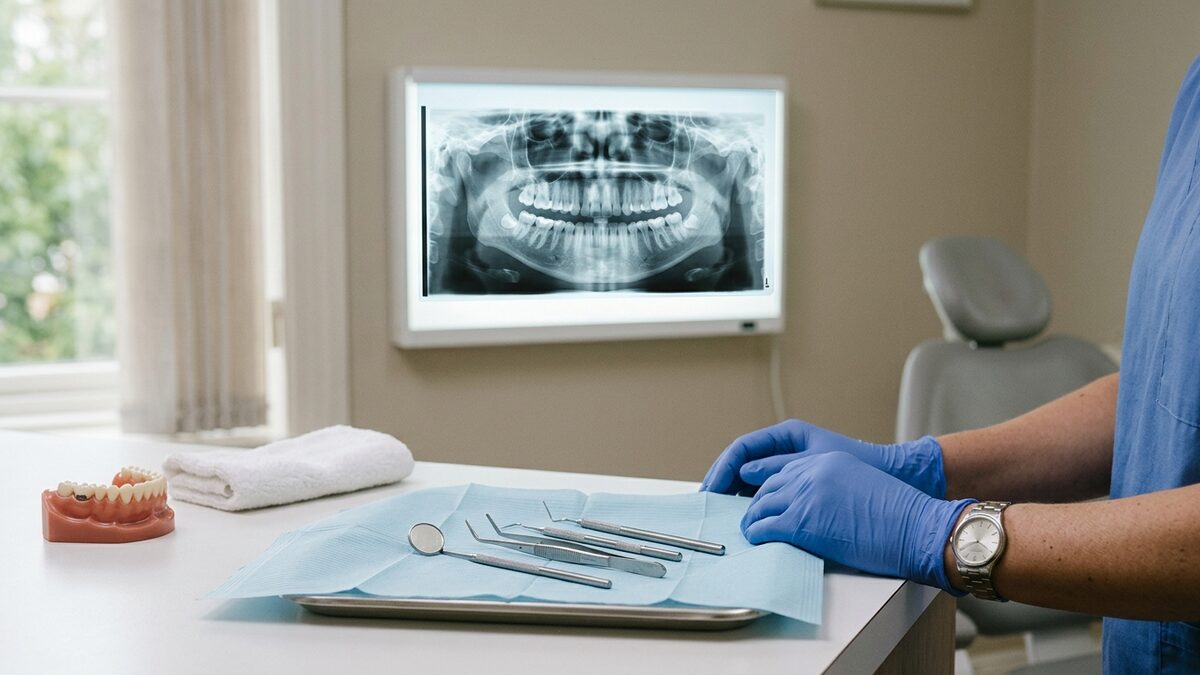
Wisdom teeth sit at the very back of the jaw, and by the time they develop the surrounding bone and neighboring molars are already established. When there is not enough room for a tooth to erupt fully, it may become impacted, meaning it stays partly or completely below the gum line or bone. Impaction is common, and it is one of the main reasons an oral surgery evaluation is recommended. An impacted tooth can press against the adjacent molar, trap food and bacteria beneath a flap of gum tissue, or remain trapped in a position that makes cleaning nearly impossible.
Not every wisdom tooth causes trouble, and not every wisdom tooth needs to come out. The clinical team evaluates each tooth based on its position, the health of the surrounding tissue, and whether it is contributing to a problem now or is likely to in the future. Panoramic or three-dimensional imaging helps show the angle of the roots and their relationship to nearby nerves and the sinus, which informs both the recommendation and the surgical plan.
Signs that prompt a wisdom tooth evaluation
Several symptoms commonly lead patients to seek an assessment. Recognizing them early can make the difference between straightforward monitoring and a more involved procedure later.
- Recurring pain or pressure at the back of the jaw, sometimes radiating toward the ear.
- Swelling or tenderness of the gum around a partially erupted tooth, which may signal an infection of the tissue flap.
- Repeated food trapping that is difficult to clean and leads to inflammation or decay.
- Crowding or shifting of the front teeth, which is sometimes attributed to third molars, though the relationship is not always direct.
- Cysts or changes on imaging, where fluid-filled sacs can form around an impacted tooth and affect nearby bone over time.
Pain is not the only reason to act. Some impacted teeth cause no symptoms yet still carry a meaningful risk of decay in the neighboring molar or damage to bone. This is why a tooth may be recommended for removal even when it does not currently hurt. The goal is to weigh the difficulty and risk of removing a tooth now against the likelihood and consequences of a problem later.
When monitoring makes sense and how recovery unfolds
Removal is not automatic. When a wisdom tooth is fully erupted, positioned well, reachable for cleaning, and free of decay or gum problems, monitoring is often the reasonable path. In these cases the tooth is checked at routine visits, and imaging is repeated periodically to confirm nothing is changing beneath the surface. Patients who choose monitoring benefit from careful home care around these hard-to-reach teeth and from reporting any new discomfort promptly.
Age is one factor providers consider. Roots are less fully formed in younger patients, and healing tends to be more predictable, which is why evaluation in the late teens is common. That does not mean older adults should not have problematic teeth addressed; it means the discussion accounts for individual anatomy and health history rather than a single rule.
When removal is recommended, the procedure ranges from a simple extraction of an erupted tooth to a surgical extraction of an impacted one, which may involve making a small opening in the gum and sometimes removing a portion of bone. Anesthesia options are discussed in advance and depend on the complexity of the case and patient preference. The surgeon reviews what to expect so there are no surprises on the day of the procedure.
Recovery typically follows a recognizable pattern. Swelling and discomfort are usually most noticeable in the first two to three days and then ease over the following week. Most patients manage discomfort with the measures their surgeon outlines, which may include cold compresses in the early hours, rest, and a soft diet. Providers generally advise avoiding straws, smoking, and vigorous rinsing in the first days, because these can disturb the healing site. Gentle salt-water rinses are often introduced after the first day to keep the area clean.
Some post-operative changes are expected rather than concerning: mild bleeding that tapers off, stiffness when opening the mouth, and temporary swelling of the cheek. Certain signs warrant a prompt call to the office instead of waiting, such as fever, increasing rather than decreasing pain after the third day, heavy bleeding that does not settle with pressure, or a bad taste with worsening pain that may indicate the healing clot has been disturbed. Patients who follow after-care instructions and attend any recommended follow-up visit tend to recover smoothly.
The decision to remove wisdom teeth is best made as a conversation. It brings together what the imaging shows, what symptoms are present, the patient's age and health, and the realistic outlook for each tooth. There is no single answer that fits everyone, and a thoughtful evaluation is designed to find the approach that fits the individual in front of the clinical team.
This article is informational and is not medical advice. Treatment options should always be made in consultation with a qualified oral surgeon.